

UPCOMING TRAINING
Q1 2027 INTAKE
Module 2, Module 3, and Module 4 are independent modules, covering different areas of financial planning.
Hence, after Module 1, these modules can be taken in any order, without following the sequence of Module 2, Module 3, and Module 4.
However, before proceeding to Module 5 (final module), candidates must complete Module 2, Module 3, and Module 4 first.
Wednesday & Friday
8:00 PM to 11:00PM
From 20 Jan 2027
Module 4
WHAT TRAINING MATERIALS DO WE PROVIDE?
One presentation slide for each topic.
Lecture notes covering everything provided in the FPAM book.
A comprehensive set of hundreds of practice questions for each topic and related subjects (some are not covered by the FPAM book) to ensure our students fully understand all subjects highlighted in the syllabus.
Multiple subjective questions to train our students to develop their own answers in the process of preparing them for the Module 5 - Paper 2 examination.
Case scenarios for group discussion to help students apply what they have learned in real-life scenarios.
Financial calculations to enhance our students' computational skills, enabling them to perform planning customization beyond the financial apps and to provide precise instructions to AI and verify the outcomes.
Mock examination to prepare students for the FPAM examination.
Supporting learning materials - External reference materials, glossary, diagrams, charts, etc.
Q1 2027 TRAINING FEES
MODULAR FEE
COMPLETE PROGRAM FEE
Online Training:
RM1,100 per module
FPAM book: RM100 per book
FIMM Exemption - RM3,788
PITO Exemption - RM3,388
Challenge Status - RM2,988
(Training for 4 modules + M1 essential topics.
Excludes FPAM textbooks)
The complete program for Challenge Status, FIMM exemption, and PITO exemption, includes:
Online training for Modules 2, 3, 4 and 5 (four modules)
FPAM books and training Materials
Essential Module 1 Topics:
Introduction to Psychology of Financial Planning
Financial Planning Process with Psychology of Financial Planning
Financial Calculations for Developing a Financial Plan
Tax Planning
Normal Enrollment - RM4,288
(Training for 5 modules. Excludes FPAM textbook)
Please contact us
GROUP / FAMILY FEE
Training commences from
Q1 2027
Saturday & Sunday
Time: 14:00 to 18:00
Examination:
TBA
Training Fee (Online)
RM1,100
Deadline
TBA
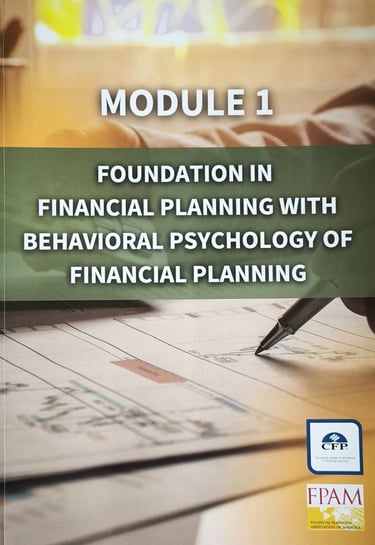
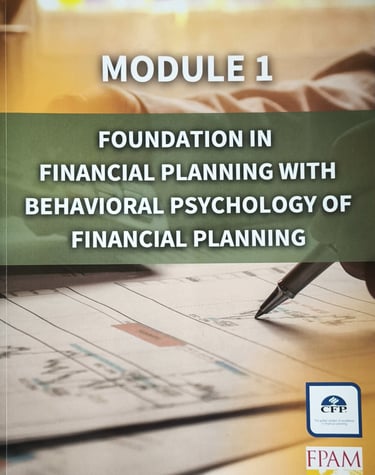
CFP Module 1
FOUNDATION IN FINANCIAL PLANNING &
PSYCHOLOGY OF FINANCIAL PLANNING
Training commences from
TBA
Examination:
TBA
Training Fee (Online)
RM1,100
Deadline
TBA
CFP Module 2
INSURANCE PLANNING & ESTATE PLANNING
Training commences from
21 Oct 2026
Wednesday & Friday
Time: 20:00 to 23:00
Examination:
12/13 December 2026
Training Fee (Online)
RM1,100
Deadline
15 October 2026
CFP Module 3
INVESTMENT PLANNING & PORTFOLIO MANAGEMENT
Training commences from
Q1 2027
Wednesday & Friday
Time: 20:00 to 23:00
Examination:
TBA
Training Fee (Online)
RM1,100
Deadline
TBA
CFP Module 4
RETIREMENT PLANNING & TAX PLANNING
Training commences from
Q2 2027
Examination:
TBA
Training Fee (Online)
RM1,200
Deadline
TBA
CFP Module 5
FINANCIAL PLAN CONSTRUCTION AND PROFESSIONAL RESPONSIBILITIES
How Do You Get the Most Out of CFP Certification?
Learn all the modules - Skipping one or two modules may develop gaps in your knowledge that will prevent you from merging financial planning components effectively.
Learn from others - CFP training provides an opportunity to learn from those with different backgrounds and experiences. Be proactive and contribute to class discussions. Always seek others' opinions to broaden your perspective and enrich your understanding.
Unlearn and relearn - CFP training differs from insurance and unit trust training. If you enroll just for the credential, believing you already know everything, you will not learn anything.
Master Time Value of Money - A weak grasp of TVM will limit your ability to analyze and customize solutions. Though most unit trust and insurance advisors learned about TVM, what they have learned is insufficient for developing a comprehensive financial plan.